
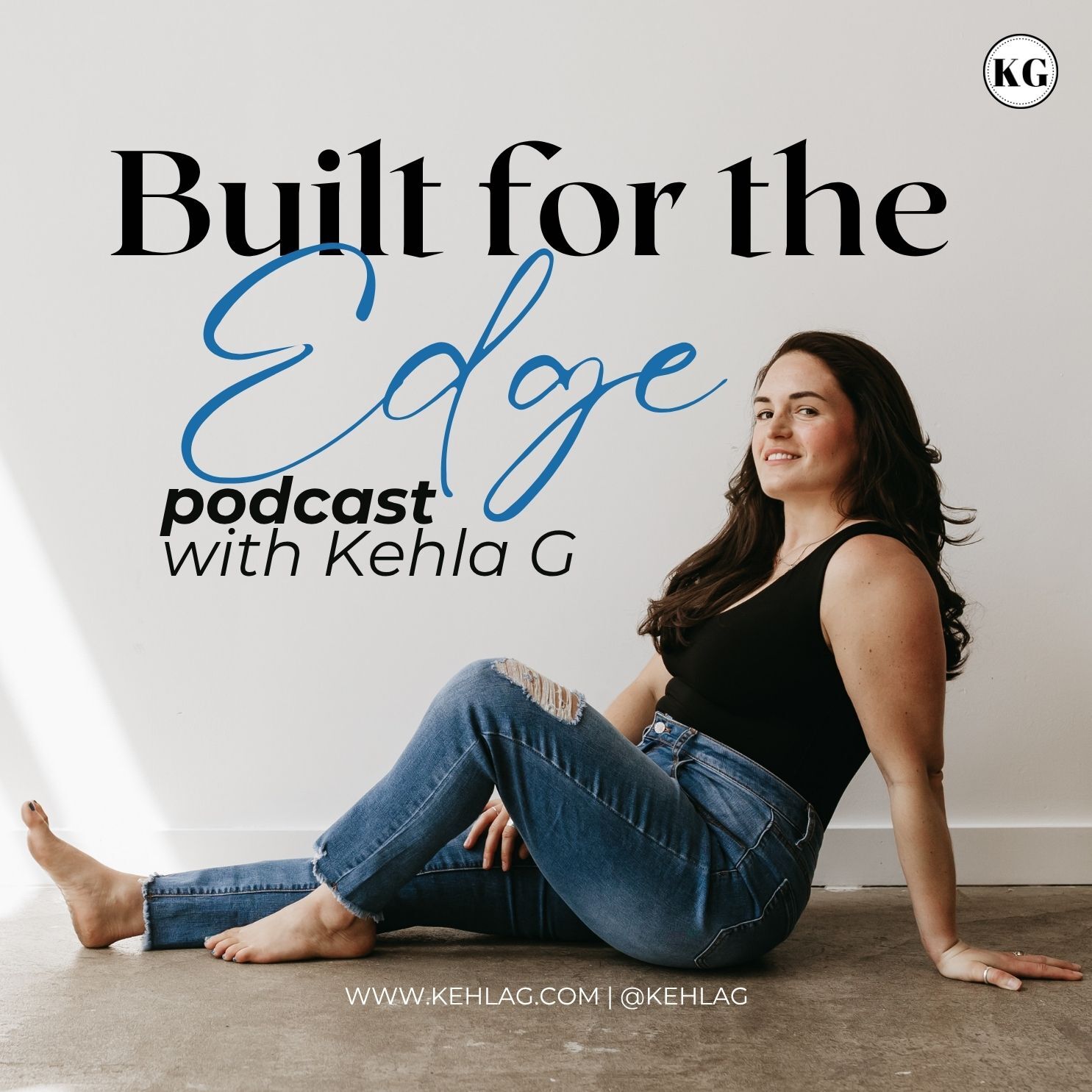
Built for the Edge is a podcast about why businesses that look successful on the surface can still feel harder to run than they should — and what it actually takes to change that.
Hosted by Kehla G., the show looks at what’s happening underneath stalled growth, founder bottlenecks, inconsistent results, and businesses that keep resetting instead of compounding.
We talk about leadership, decision-making, business architecture, measurement, and what needs to change when too much of the business still depends on the founder.
Some episodes are solo. Some are conversations with founders, operators, and people who think differently about how businesses grow. The question underneath all of them is usually the same: what is actually happening here, and what would need to change for this business to work better?
If you’ve already built something, know how to sell, and still feel like the business requires more effort than it should, you’re in the right place.
550+ episodes. Ranked in the top 2% of podcasts globally.
Instagram: @kehlag
If you’re in Canada — especially British Columbia — connect with me on LinkedIn: @kehlag
www.kehlag.com
hello@kehlag.com
Episodes
Jul 26, 2026
Jul 26, 2026
7 min
Entrepreneurs are no strangers to advice.
Raise your prices. Launch again. Work on your mindset. Become more magnetic. Heal your money blocks.
But what if none of those are actually the problem?
In Part 1 of this four-part series, Kehla G challenges one of the biggest patterns in the online business space: prescribing solutions before diagnosing the real issue.
In this episode, Kehla explores why so many entrepreneurs mistake symptoms for root causes, how that cycle slowly erodes self-trust, and why even the best strategies, mindset work, or identity work can fall flat when they're applied to the wrong problem.
Listeners will learn:
- Why so many business owners feel like they've "tried everything" without making meaningful progress.
- The difference between symptoms and root causes in business.
- Why the quality of any solution depends on the quality of the diagnosis.
- What it really means to build a business that makes sense.
- How understanding the mechanics of a business changes the way decisions are made.
This episode marks the beginning of A Business That Makes Sense, a four-part series exploring the foundations of sustainable business growth and why clarity—not complexity—is often the missing piece.
Connect with Kehla:
Jul 22, 2026
Jul 22, 2026
7 min
Most business owners assume the next stage of growth requires more capacity—more time, more hires, more systems, or more leads. But what if that's the wrong problem to solve?
In this episode, Kehla G explores the difference between capacity and capability, and why confusing the two can quietly turn founders into the biggest bottleneck in their own business. Through practical examples from hiring, sales, leadership, and delegation, she unpacks how businesses become increasingly dependent on their owners despite adding more people and resources.
If you've ever felt like your business can't move without you, this conversation will challenge the way you think about scaling. Because sustainable growth isn't built by doing more—it's built by creating a business that's capable of more.
Kehla's Website
Work with Kehla
Follow Kehla on IG
Follow Kehla on LinkedIn
Jul 19, 2026
Jul 19, 2026
14 min
Everyone keeps saying we have a trust problem.
But what if that's not what's happening at all?
In this episode, Kehla unpacks why AI didn't create a crisis of trust—it exposed a much bigger shift that's already been unfolding. Through the lens of three Gene Keys (13th, 17th & 18th), she explores why opinion has become cheap, why discernment is becoming one of the most valuable business skills of the next decade, and why integrity—not information—will be the true competitive advantage.
If you've been wondering how to stand out in a world where everyone has access to the same knowledge, this episode will challenge the way you think about expertise, trust, AI, and what it really takes to build a business that people believe in.
Actualize your Genius with the Pearl e-book
Kehla's Website
Work with Kehla
Follow Kehla on IG
Follow Kehla on LinkedIn
Jul 15, 2026
Jul 15, 2026
25 min
Grief is often treated as something we need to get through. But what if it's actually trying to guide us somewhere?
In this episode, Business Architect Kehla G sits down with grief coach, transition strategist, and founder of Mind the Transitions, Rosalind Price, for a conversation that challenges almost everything we've been taught about grief.
Together, they explore why grief isn't limited to death, but can show up through career changes, marriage, moving, health challenges, identity shifts, and any life transition that changes who we are. Rosalind introduces her concept of grief intelligence, explaining why learning to recognize and work with grief can create greater resilience, clarity, and self-awareness instead of keeping us stuck.
Throughout the conversation, Kehla and Rosalind share personal experiences of navigating change while unpacking why grief is far more expansive than sadness, why every person's journey looks different, and how the greatest transformations often begin when we stop resisting what we're feeling.
If you've ever found yourself wondering why a major life transition feels heavier than expected, this conversation offers a completely different lens on what grief really is—and how it may be helping you become who you're meant to be.
Connect with Rosalind:
Website
LinkedIn
Facebook
Substack - The Grief Gangstress
Grab the Grief Blueprint
Kehla's Website
Follow Kehla on IG
Follow Kehla on LinkedIn
Jul 12, 2026
Jul 12, 2026
8 min
AI has made information more accessible than ever before. Marketing strategies, sales scripts, business frameworks, and even the thinking behind some of the world's most successful entrepreneurs are now available in seconds. So if everyone has access to the same answers, what actually creates a competitive advantage?
In this solo episode, Kehla explores why information is no longer the differentiator it once was and why the real bottleneck isn't a lack of knowledge—it's our ability to accurately diagnose what's actually happening. She unpacks why AI can only reason from the evidence it's given, how our blind spots shape the questions we ask, and why observation, judgment, and pattern recognition are becoming the most valuable skills in business.
If you've ever found yourself searching for better answers while still feeling stuck, this episode may change the way you think about AI, expertise, and the future of decision-making.
Jul 8, 2026
Jul 8, 2026
8 min
For years, the personal development industry has encouraged us to become someone else. Become your future self. Act as if. Embody the version of you who already has the life you want. But what if that advice has unintentionally given your future self more authority than your present reality?
In this solo episode, Kehla explores the difference between vision and reality, and why those two things shouldn't be confused. Drawing from a recent conversation, her own experience filing a consumer proposal, and years immersed in personal development, she unpacks a new way of thinking about growth: one that starts with accurately seeing your current conditions rather than trying to embody an imagined future identity.
You'll hear why identity may not be the starting point of transformation at all, but rather the result of repeatedly responding well to reality. Kehla also explores the difference between maps and territory, why discernment is one of the most underrated skills in business and life, and the simple question that has fundamentally changed how she makes decisions.
If you've ever felt exhausted trying to "become" the next version of yourself, this episode offers a different lens—one that invites you to stop consulting an imagined future and start responding to the reality that's already in front of you.
Jul 5, 2026
Jul 5, 2026
24 min
Most coaches assume that if they had more leads, more followers, or a better funnel, they'd have more clients.
But what if the real issue isn't visibility?
In this episode, Kehla sits down with marketing and sales strategist Hailey Rowe for a conversation about what actually moves people from awareness to action. Together, they unpack the often-overlooked gaps between attracting attention, building trust, and creating momentum that leads to sales.
They explore:
- Why more visibility doesn't automatically create more clients
- The common marketing mistakes that quietly cost coaches sales
- How to evaluate where prospects are getting stuck in your funnel
- The role trust plays in converting leads into paying clients
- What AI can and can't do when it comes to marketing and business growth
- Why business owners need to zoom out and look at the entire customer journey
Whether you're struggling to get leads, convert inquiries, or create more consistency in your business, this conversation offers a practical look at the relationship between marketing, sales, and the client journey.
This episode is less about finding another marketing tactic and more about understanding what needs to happen between visibility and sales for a business to grow.
Free Class & Action Plan- The 5 Posts to Book Your Next 10 Discovery Calls
Hailey's Website
Follow Hailey on Instagram
Follow Hailey on Facebook
Health Coach Nation Podcast
Follow Hailey on LinkedIn
Jul 1, 2026
Jul 1, 2026
6 min
In this solo episode, Kehla shares a realization that came out of a recent Growth Club event while working with business owners on delegation, accountability, and team development. Drawing on the well-known phrase, "Teach someone to fish and they'll eat for a lifetime," she challenges listeners to consider what's missing from the conversation.
Most business owners focus on whether their team can do the work. Very few stop to ask whether their team can teach someone else how to do it.
Kehla explores the difference between competency and transferability, why knowledge often gets trapped inside key people, and how businesses unknowingly create new bottlenecks even after delegating tasks. She breaks down the hidden structural issue underneath many growth challenges and explains why creating more teachers—not just more doers—is what allows a business to scale without remaining dependent on the owner.
If you've ever felt like everything still comes back to you, no matter how much you've delegated, this episode will change the way you think about leadership, leverage, and what it actually means to build a business that holds.
Jun 28, 2026
Jun 28, 2026
9 min
In this episode, Kehla explores a realization that emerged from observing how differently people can respond to the exact same situation. What started as curiosity about her own thinking led to a deeper question: why do some people get stuck managing symptoms while others instinctively look for the source?
Kehla unpacks why she's less interested in the event itself and more interested in the structure producing it. She shares how this lens shows up in her coaching, decision-making, and business work, and why understanding has always been more valuable to her than reassurance. The conversation explores the difference between symptoms and root causes, why business owners often mistake structural problems for emotional ones, and how looking beneath the surface can create more clarity, freedom, and momentum.
If you've ever found yourself stuck in overwhelm, frustration, confusion, or endless processing, this episode offers a different question to ask: not how to manage the symptom, but what might be producing it in the first place.
Jun 24, 2026
Jun 24, 2026
31 min
What if the problem isn't that you're not creating enough content?
What if you're creating too much of the wrong kind?
In this conversation, Jana Osofsky shares a radically different approach to content marketing—one that prioritizes building assets over feeding algorithms. Instead of chasing consistency, trends, and endless content calendars, she teaches business owners how to create a small library of evergreen content that continues moving people toward a buying decision long after it's published.
Kehla and Jana explore why most content educates without converting, how to identify the specific conversations your audience needs before they're ready to buy, and why repetition is often more valuable than creating something new. They also unpack the role of AI in content creation, where it helps, where it hurts, and how to use it without losing your voice in the process.
If you've ever felt exhausted by content marketing, overwhelmed by the pressure to constantly create, or frustrated that your content isn't leading to sales, this episode offers a simpler and more sustainable way forward.